
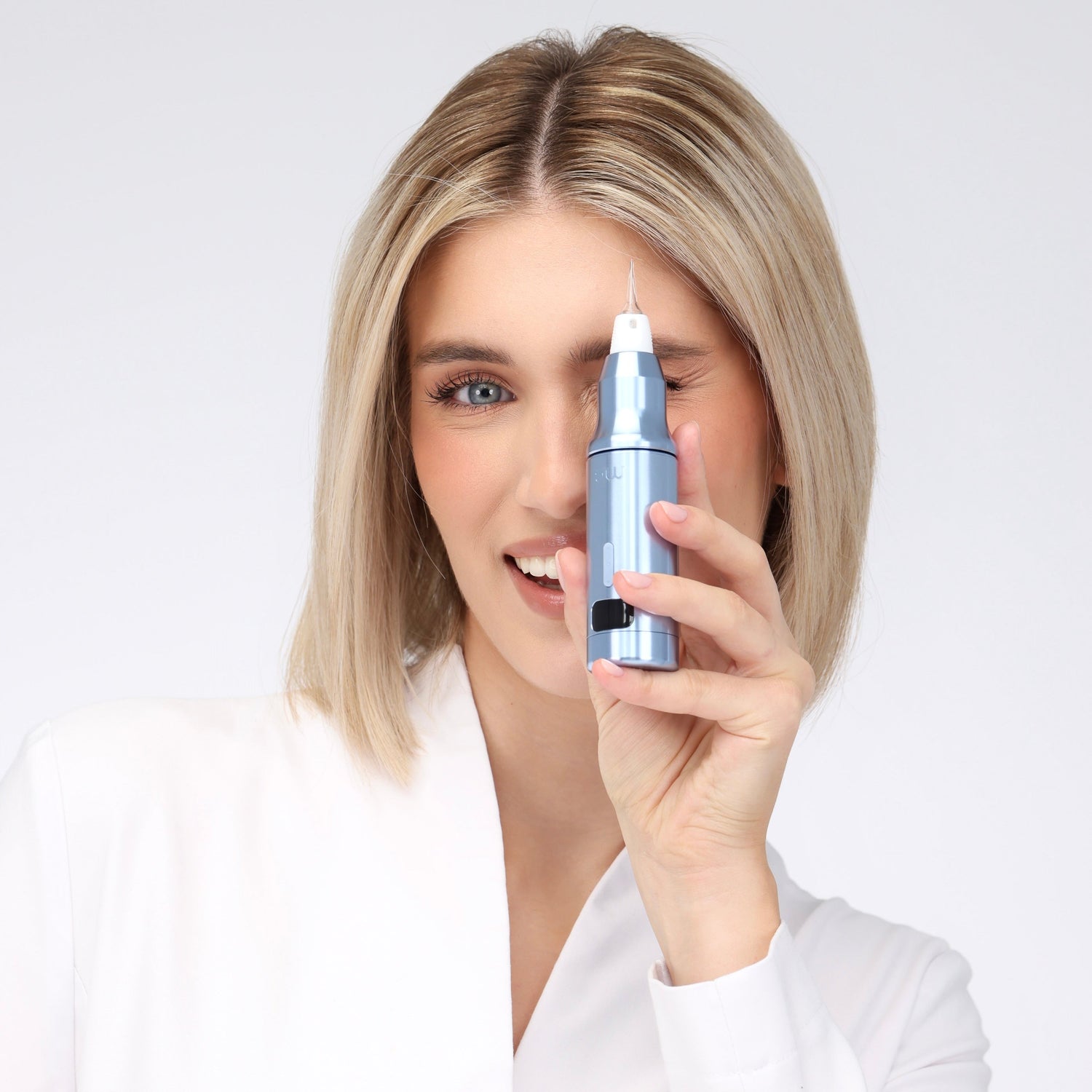
Is There a Single “Ideal” Stroke?
Although the topic of stroke has already been discussed many times, it is worth taking another look at this issue from the perspective of device engineering and the artist’s practical work. A conscious choice of stroke length plays a significant role both in machine design and in achieving predictable, repeatable pigmentation results.
What Stroke Means in Mechanical Terms
The needle stroke is the linear distance the needle travels in one full operating cycle of the device, from its highest to its lowest point. This motion is generated by the motor and drive system, in which the eccentric converts the rotary motion of the motor shaft into the reciprocating motion of the needle.
In practice, the stroke defines the total range of needle motion and affects such dynamic parameters as needle contact time with the skin, acceleration, and the mechanical energy transferred during each impact.
The stroke is a geometric parameter that defines only the path of the needle’s movement. By itself, it does not determine the device’s power or impact force, as these depend on the drive design, motor torque, and the way energy is transferred to the needle.
The Importance of a Balanced Design
Stroke length alone does not define the quality of a device’s performance.
Its efficiency depends on how well the following elements work together:
-
the type of motor (brushed, coreless, or brushless),
-
the torque characteristics,
-
the gear ratio and eccentric geometry,
-
the stability of the electronic control system and power supply.
Only a properly balanced system allows the needle to move smoothly, steadily, and in a controlled way. Two devices with the same stroke can work completely differently.
One will be predictable and even, while the other may be unstable, noisy, or less efficient, depending on the quality of engineering throughout the design.
Stroke Efficiency and the Role of Device Construction
Stroke efficiency is primarily a function of device construction, its drive, mechanics, and control system. The artist’s preferences and technique, along with the choice of pigment and work adjusted to the skin type, translate the potential of that construction into procedure efficiency.
It is the mechanics and engineering that determine whether a given stroke truly performs as it should. Two devices can have the same stroke value in their specifications yet behave very differently in practice. One will run smoothly and steadily, while the other stiffly, unevenly, with higher vibration.
This is why the number in the product specifications alone is not enough.
Stroke is only geometry, and how that geometry is utilized depends on the engineering, the drive system, and the overall mechanical design.
2.8 mm vs 3.5 mm Stroke — Differences in Work Characteristics
| Stroke length | Mechanical features | Work characteristics |
|---|---|---|
| 2.8 mm | Shorter movement, lower acceleration, shorter skin contact time | Softer needle impact, gentler pigment implantation, gradual saturation build-up |
| 3.5 mm | Longer movement, higher acceleration, longer skin contact time | Stronger impact, greater pigment load per hit, faster skin saturation |
Both stroke ranges allow the execution of any pigmentation technique, provided that the artist consciously controls other parameters such as speed, hand pressure, and needle protrusion.
Can One Device Be “Universal”?
“Universality” does not mean that every device maintains a constant torque regardless of conditions.
The stability of perceived power results from drive and control engineering.
-
In open-loop systems (operating “on voltage,” without current measurement or feedback), typical for many brushed and coreless DC constructions, torque and speed change with load and supply level (for example, when battery voltage drops).
-
In systems with current control / PWM and feedback (encoder, Hall sensors, or FOC), it is possible to maintain a set torque characteristic up to the base speed, provided that power and thermal conditions allow it.
Therefore, we understand “universality” as this: both a shorter (2.8 mm) and longer (3.5 mm) stroke can deliver excellent results if the device is properly engineered and the artist consciously manages parameters.
-
2.8 mm → shorter skin contact, smaller pigment deposit per hit → more layered, delicate work.
-
3.5 mm → longer contact, larger pigment deposit per hit → lighter hand, less pressure, and with proper drive design often a shorter overall procedure time.
The 3.5 mm variant requires a drive and control system capable of maintaining torque under load (with proper electronics and power management) to ensure that the stroke remains effective rather than “empty.”
Needle Protrusion — a Complementary Parameter
Regardless of stroke length, correct needle protrusion settings are critical for stable pigment flow and controlled implantation depth.
Recommended protrusion values:
-
for 2.8 mm stroke → 1.4–2.0 mm,
-
for 3.5 mm stroke → 1.75–2.0 mm.
Excessive protrusion limits pigment pickup (the needle spends too little time inside the cartridge chamber), while too little protrusion makes it difficult to control the actual implantation depth and can cause unpredictable pigment behavior in the skin.
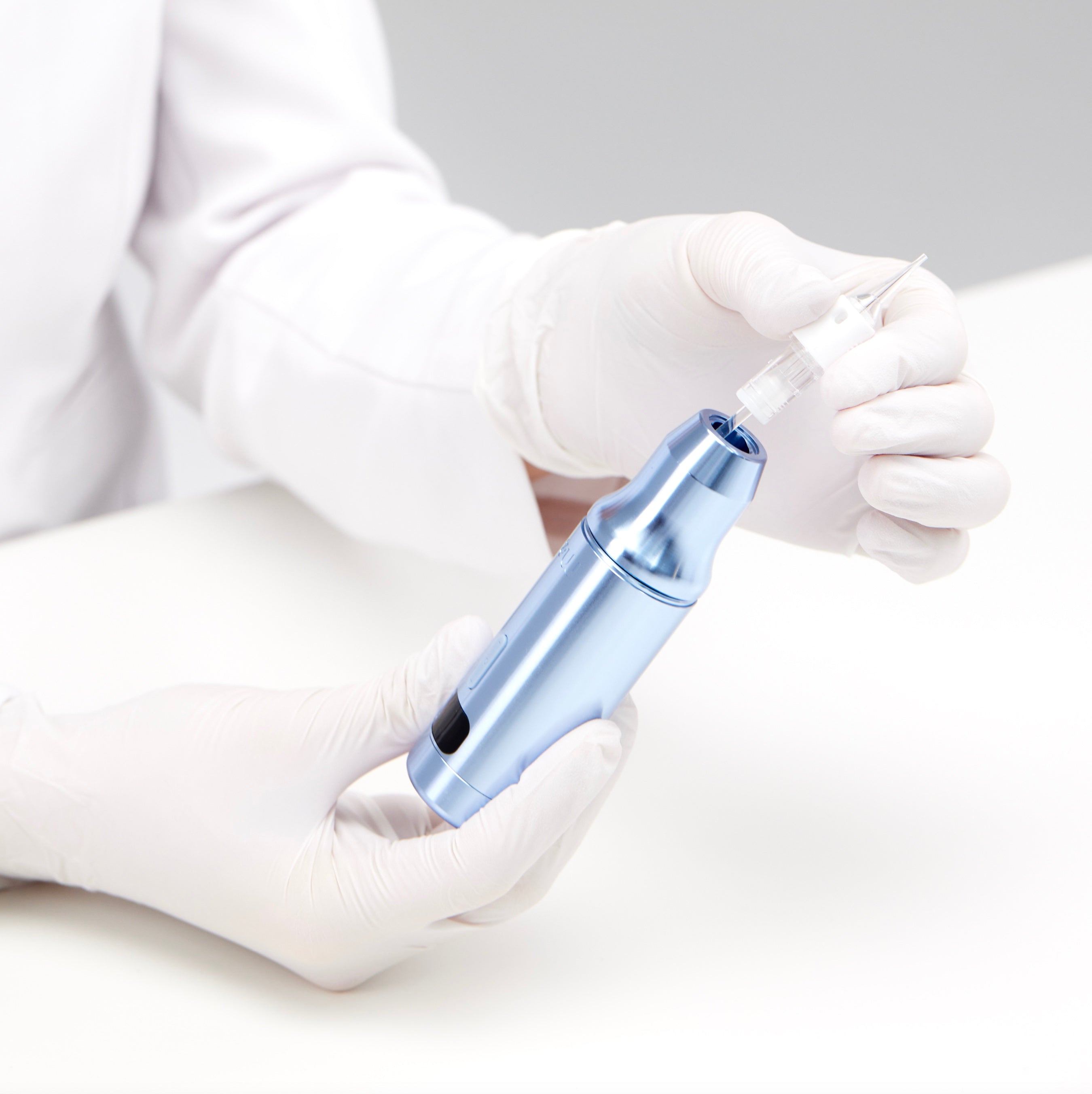
The goal is to ensure that in each cycle, the needle can fully retract into the cartridge chamber, pick up a new portion of pigment, and maintain continuous, even flow during work.
During each needle movement cycle, three phases occur:
-
Extension – the needle exits the cartridge.
-
Contact with tissue – pigment implantation occurs.
-
Retraction – the needle returns to the cartridge chamber, where it collects a new portion of pigment.
The retraction phase is critical because it is at this moment that the needle collects pigment from the cartridge chamber, ensuring even coating and stable pigment flow in subsequent impacts.
Summary
There is no single “ideal” stroke.
Work efficiency depends on both device engineering and the artist’s conscious parameter control. Understanding the interdependence between stroke, torque, needle protrusion, and speed allows the artist to adjust their technique to different pigments, skin types, and methods.
There is also no “better” or “worse” stroke, just as there is no “better” pencil.
An artist does not compare H, HB, B1, or B5 to decide which is universally superior.
They simply choose the tool that best matches the desired effect and their own style of work.
It is the same with PMU devices. Each has its own characteristics, and the ability to understand and use them is crucial. Conscious adaptation of technique to the construction and behavior of the device enables consistent, predictable, and repeatable results across different skin types and treatment areas.
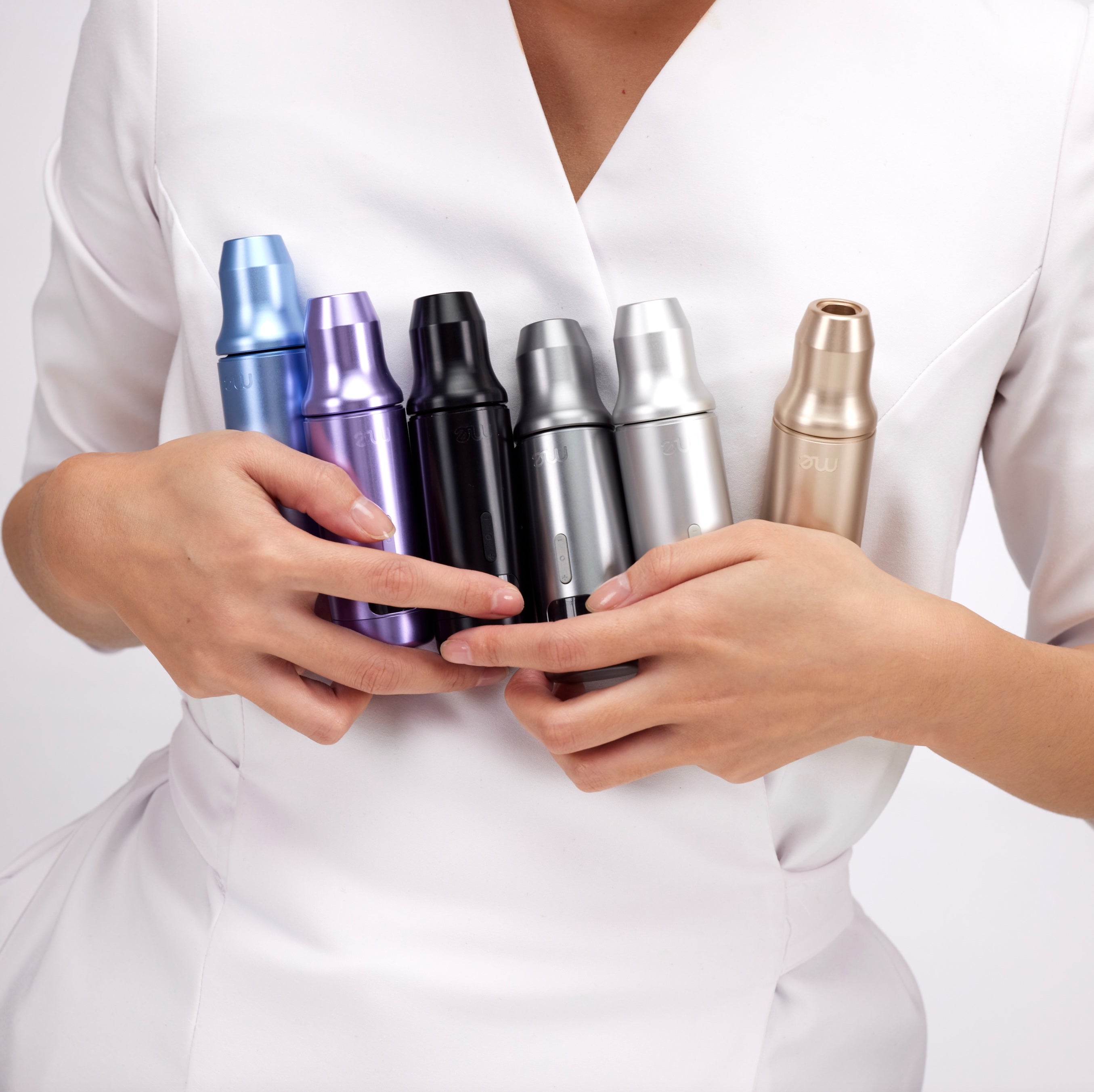
In practice, it is worth having two devices with different strokes, a shorter and a longer one, to precisely match the tool to each procedure and the individual needs of the work.

Leave a comment
All comments are moderated before being published.
This site is protected by hCaptcha and the hCaptcha Privacy Policy and Terms of Service apply.