

There is one question I hear at almost every PMU training, workshop and demonstration:
“What speed are you working at?”
For years, the answer has usually sounded something like:
“5 volts.”
“7 volts.”
“7.5 volts.”
And we all understood what the question meant.
The problem is that voltage is not speed.
It has simply been used by our industry as a convenient way of describing machine settings. And as PMU machines become more technically advanced, understanding the difference becomes increasingly important.
So what are volts?
A volt (V) is a unit of electrical potential difference.
In very simple terms, voltage tells us about the electrical input supplied to a system. It does not directly tell us how many times the needle moves up and down per second.
On many traditional PMU machines, increasing voltage causes the motor to rotate faster, which makes the needle cycle faster. That is why artists naturally started treating the voltage displayed on the power supply as a speed setting.
Higher V = generally faster.
Lower V = generally slower.
As a practical reference within one particular machine and power-supply setup, this can work perfectly well.
But it does not make volts a measurement of speed.
Why can't we compare machine speed using volts?
Imagine two completely different PMU machines, from two different manufacturers, with different motors, electronics, drive systems and power supplies.
You set both to 7 V.
Are they now working at exactly the same speed?
No.
One machine may be significantly faster than the other.
The voltage alone doesn't tell you the motor RPM or how many complete needle cycles are occurring every second. The relationship between supplied voltage and actual mechanical speed depends on the construction and control system of that particular machine.
So when someone says:
“I work at 7 volts.”
we know the machine's setting, but we still don't know its actual speed unless we know the characteristics of that specific machine.
This is why voltage-based settings are much more useful for describing relative ranges:
slow → medium → moderately fast → fast
rather than giving an exact, transferable speed between different machines.
Then what is Hz?
Hz stands for hertz and is a unit of frequency.
1 Hz = 1 cycle per second.
If the mechanism of a PMU machine is designed so that one complete motor revolution produces one complete needle cycle, then:
60 Hz = 60 motor revolutions per second = 60 complete needle cycles per second.
The needle completes the sequence:
up → down → up
60 times every second.
That is fundamentally different from saying that the machine is operating at 6 V or 7 V.
Voltage describes an electrical quantity.
Hertz describes frequency.
And frequency is what allows us to describe how often the machine actually performs a repeating mechanical cycle.
Why did we choose Hz for ME™?
When we were developing ME™, we knew we wanted to move away from settings that only tell an artist that the machine is working somewhere around slow, medium or fast.
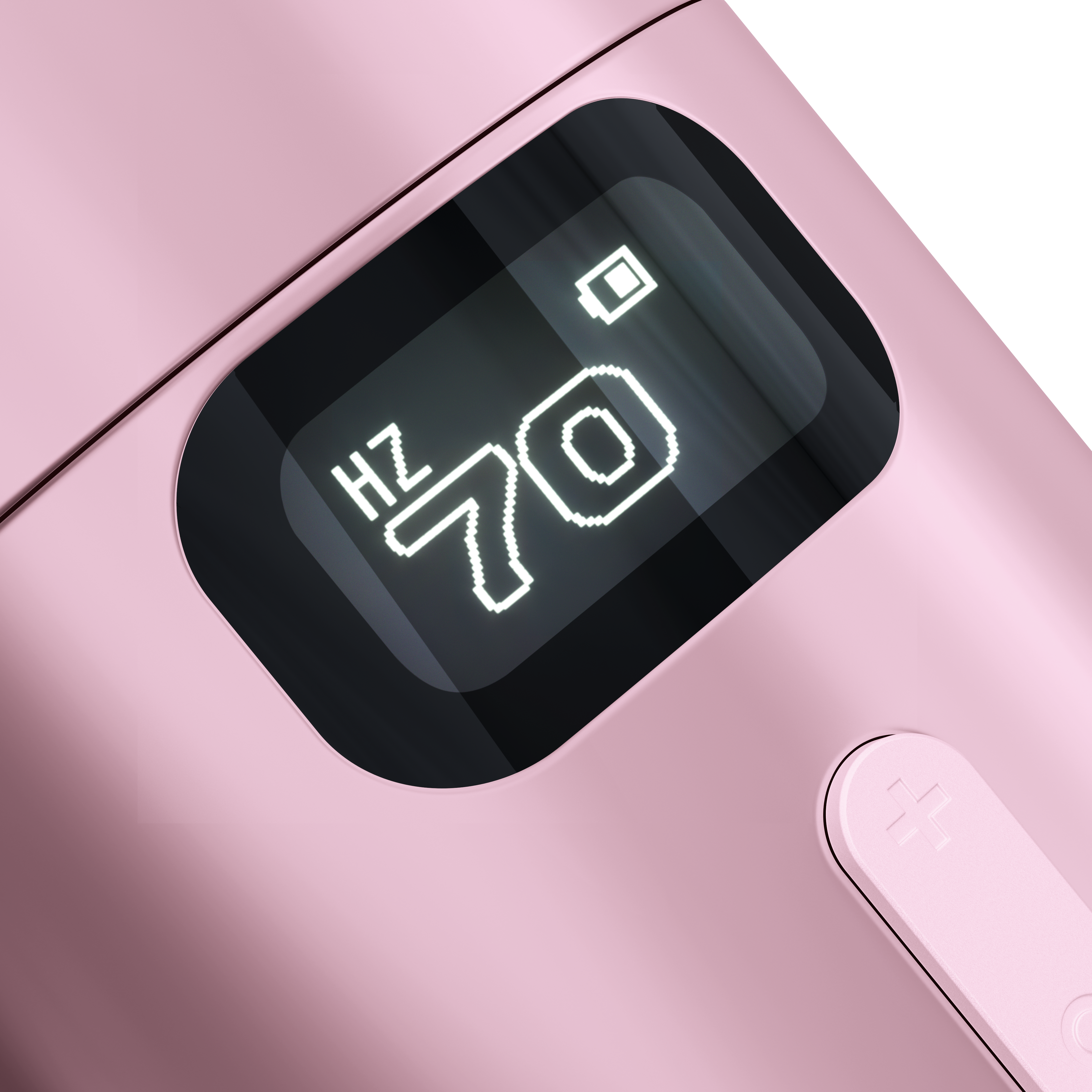
We wanted the number on the display to correspond to an actual mechanical frequency.
With ME™, the relationship is direct:
1 Hz = 1 motor revolution per second = 1 complete needle cycle per second.
So:
25 Hz = 25 cycles per second
50 Hz = 50 cycles per second
60 Hz = 60 cycles per second
100 Hz = 100 cycles per second
If I tell another ME™ artist that I am working at 55 Hz, we are referring to an actual defined frequency rather than an approximate interpretation of a voltage setting.
This was particularly important to us from an educational perspective.
Instead of asking:
“What voltage do you use?”
we can finally start asking the technically correct question:
“At what frequency are you working?”
But I've seen other machines displaying Hz. Isn't that the same thing?
Not necessarily.
This is an important distinction.
Displaying “Hz” on a screen does not automatically prove that the displayed number represents the machine's actual mechanical frequency.
A manufacturer can create a numerical scale and label it Hz, just as a machine can display levels or other proprietary values.
For a value to represent actual frequency, there needs to be a defined relationship between the displayed value and the physical cycles performed by the mechanism.
So when comparing machines, don't assume that 60 Hz displayed on Machine A automatically means the same mechanical speed as 60 Hz displayed on Machine B.
The relevant question is:
Does the displayed Hz value correspond to the machine's actual cycles per second?
Does 60 Hz mean the needle hits the skin 60 times per second?
This requires one more distinction.
Needle cycles per second are not automatically the same thing as actual pigment implantation points per second.
At 60 Hz, the mechanism performs 60 complete cycles every second.
But whether every cycle creates contact with the skin depends on how the artist works: hand speed, movement, needle hang, pressure, angle, stretch, technique and contact with the tissue all matter.
So Hz describes the machine frequency, not the number of visible pixels you will necessarily create in the skin.
Does higher Hz mean more power?
No.
This is another common misconception.
Speed and power are not the same parameter.
A machine can operate at a particular frequency and still behave very differently under load depending on its motor, torque characteristics, electronics, stroke, drive mechanism and control system.
This is why two machines working at the same true frequency can still feel completely different in the skin.
And it is also why choosing a PMU machine based purely on its maximum Hz makes very little sense.
Faster does not automatically mean stronger, more effective or better.
Does the same Hz mean the same result?
No.
Knowing the actual frequency finally gives us a meaningful measurement of speed, but speed is only one part of pigmentation.
The final interaction between the needle and tissue is influenced by:
-
stroke length,
-
machine mechanics,
-
motor behaviour under load,
-
needle configuration,
-
hand speed,
-
movement pattern,
-
pressure,
-
needle hang,
-
skin resistance,
-
and the way the machine controls each cycle.
Two machines can therefore operate at the same frequency and still produce a very different working sensation and tissue response.
So should we stop talking about volts?
Not completely.
If your machine uses volts, there is nothing wrong with saying that you work at 6 V or 8 V when discussing settings for that particular machine.
The problem begins when voltage is interpreted as a universal measurement of speed.
It isn't.
7 V tells you the voltage setting.
60 Hz tells you a frequency of 60 cycles per second — provided the machine's displayed Hz represents its actual mechanical frequency.
That distinction matters.
After years of answering “What speed are you working at?” with a voltage number, we can finally separate two things that were never technically the same in the first place:
V is voltage.
Hz is frequency.
And frequency is how we can actually describe machine speed in cycles per second.


Leave a comment
All comments are moderated before being published.
This site is protected by hCaptcha and the hCaptcha Privacy Policy and Terms of Service apply.